Python Resume Examples for Developers (2026)
See 3 Python developer resume examples (entry-level, mid-level, senior). Copy the summaries, bullet points, skills and ATS keywords that get Python interviews.
A strong Python resume does not say "Python (advanced)" and stop there. It shows what you build with Python (web APIs, data pipelines, automation, machine learning), which part of the Python ecosystem you use to build it (Django, FastAPI, pandas, Celery, pytest), and what got faster, cheaper or more reliable because of your code. Below are three complete Python developer resume examples, one each for an entry-level developer, a mid-level backend developer and a senior tech lead, followed by the summaries, bullet points, skills and ATS keywords you can adapt for your own resume.
"Python" appears in thousands of job posts for very different jobs. A recruiter hiring a Django backend developer and one hiring a data engineer are scanning for different words. Decide which kind of Python developer you are before you write a single bullet, then make the top third of your resume say it.
Python Developer Resume Examples
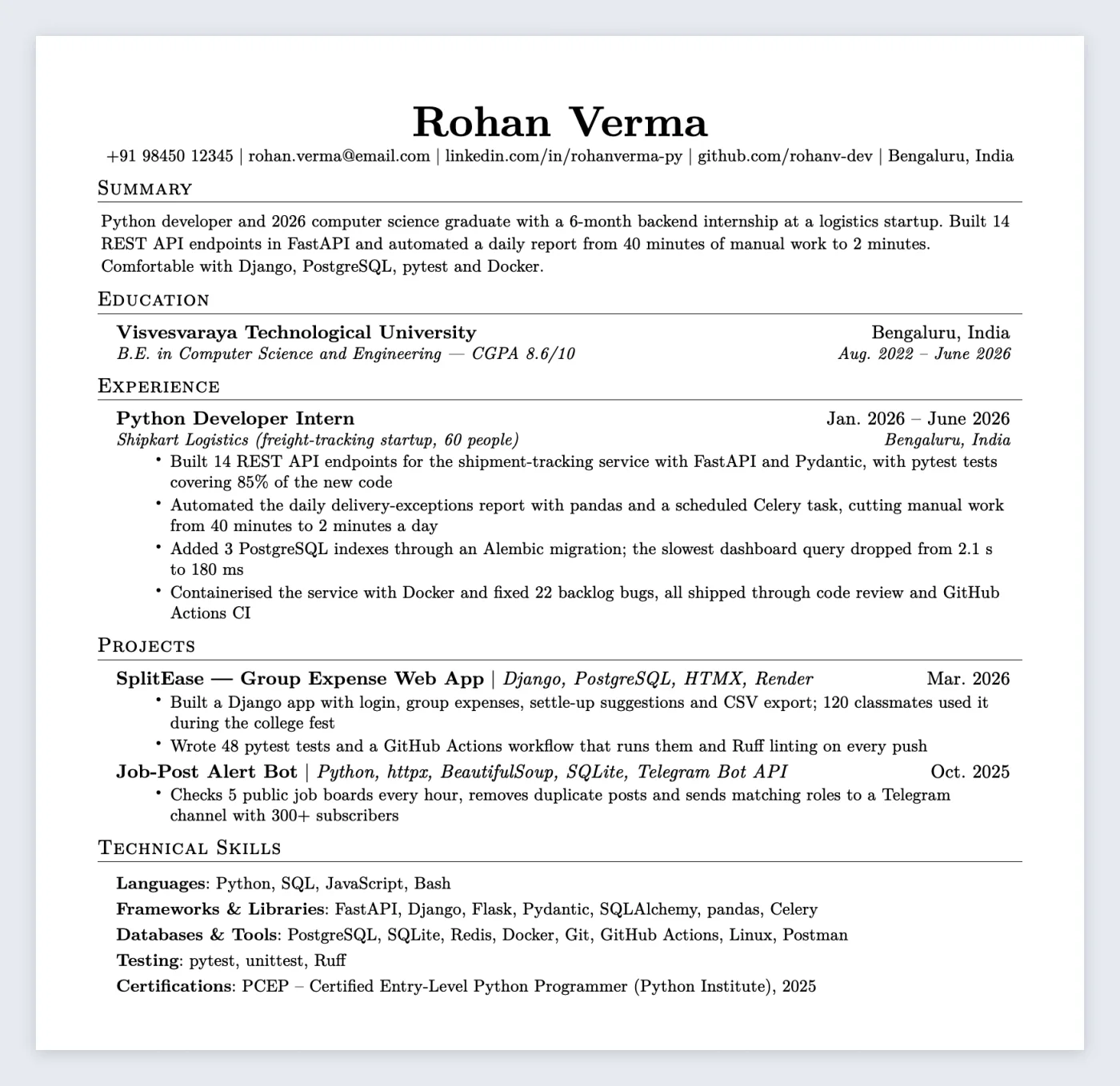
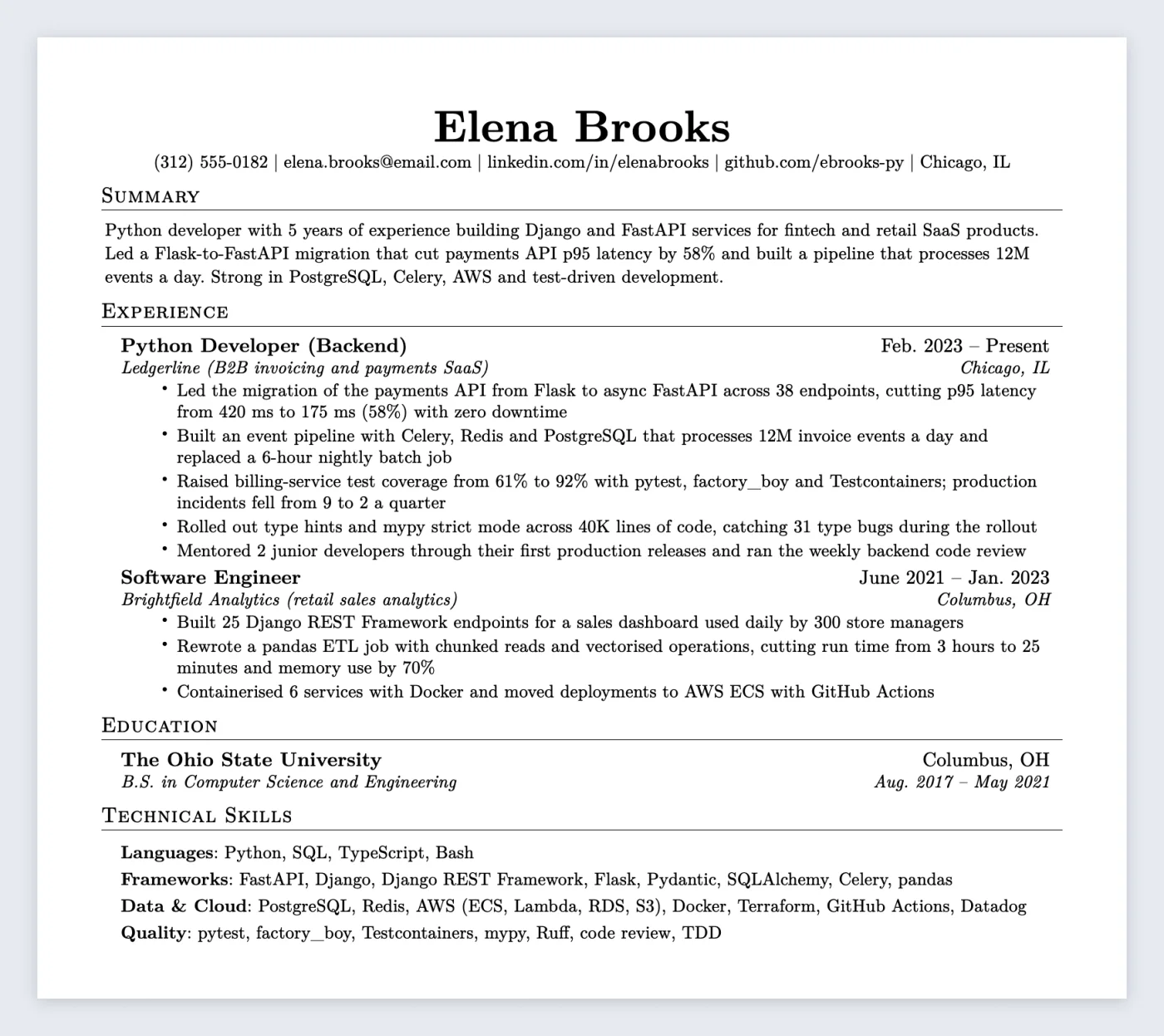
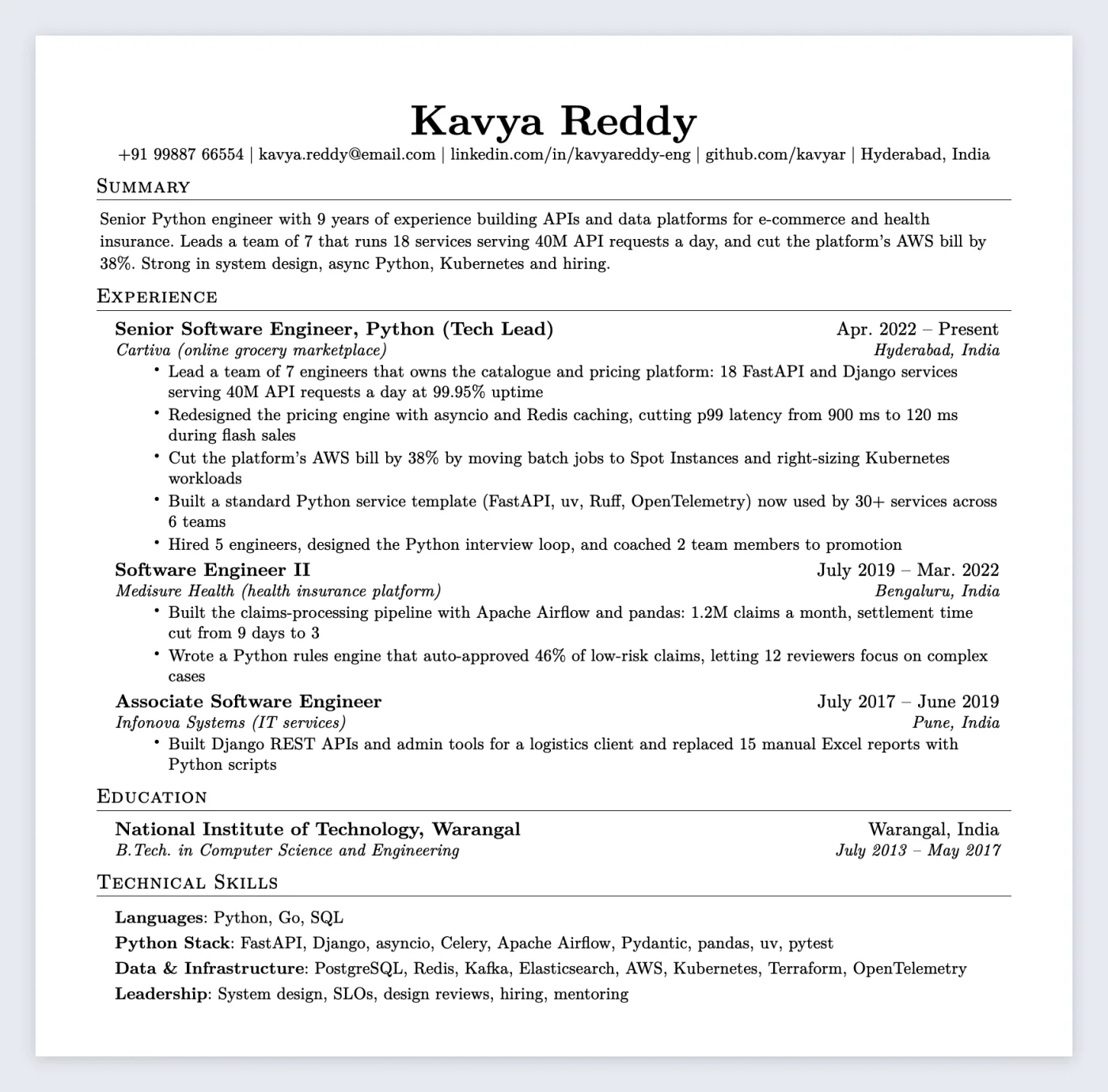
Each example below is a full one-page resume built with the free Jake's Resume template, a single-column layout that parses cleanly in applicant tracking systems (ATS). The names and companies are made up; the tools, numbers and structure are realistic for each level. Click any resume to open it full size.
Entry-Level Python Developer Resume Example (Fresher)
Why this resume works:
- The internship reads like a real job. Each bullet names a Python tool (FastAPI, pandas, Celery, Alembic) and a result (a 40-minute report cut to 2 minutes, a query cut from 2.1 s to 180 ms).
- Testing shows up early. "pytest tests covering 85% of the new code" tells a hiring manager this fresher already writes tests.
- Projects have users. 120 classmates and 300+ bot subscribers prove the code ran for real people, which a tutorial project never does.
- The PCEP certificate sits in the skills block because at this level it supports the projects rather than replacing them.
Mid-Level Python Developer Resume Example (Backend)
Why this resume works:
- The summary leads with the two biggest numbers, both of which are backed by bullets below: p95 latency down 58% and 12M events processed a day.
- It shows Python depth, not just Python. Async FastAPI, Celery, mypy strict mode and Testcontainers signal real production work.
- Quality has a business result. Coverage rising from 61% to 92% matters because incidents fell from 9 to 2 a quarter.
- The older job is shorter, which keeps the page focused on recent, harder work.
Senior Python Developer Resume Example (Tech Lead)
Why this resume works:
- Scale is stated plainly: 18 services, 40M API requests a day, 99.95% uptime. A senior resume has to show the size of what you own.
- Money and people both appear: a 38% cut to the AWS bill, 5 engineers hired and 2 promoted.
- A service template used by 30+ services proves influence beyond one team.
- The first job gets one line, so nine years still fit on a single page.
Which Kind of Python Developer Are You?
Most weak Python resumes try to be every kind of Python developer at once. Pick the path that matches your target jobs and let it decide your summary, first bullets and skills order.
| Python path | Lead your resume with | Proof that lands |
|---|---|---|
| Web / backend developer | Django, FastAPI or Flask, REST APIs, PostgreSQL, Celery, Docker | Endpoints shipped, latency, uptime, users served |
| Data engineer | pandas, PySpark, Airflow, SQL, dbt, cloud warehouses | Rows or events processed, pipeline run time, data freshness |
| Data scientist / ML engineer | NumPy, scikit-learn, PyTorch, Jupyter, MLflow | Model metrics tied to business results |
| Automation / scripting | Python scripts, APIs, Selenium or Playwright, cron, Bash | Hours saved, manual steps removed, error rates |
| Test automation (SDET) | pytest, Playwright, Robot Framework, CI pipelines | Tests automated, regression time, escaped defects |
The examples above follow the first path. For analytics or machine learning roles, see our data scientist resume example.
How to Format a Python Developer Resume
Use a single-column, reverse-chronological layout and send a PDF unless the job post asks for Word. Text boxes, icons and skill bars can be read out of order or skipped by older ATS parsers.
The right section order depends on your experience:
| Experience level | Section order | Length |
|---|---|---|
| Fresher / 0–1 years | Summary, Education, Experience or Internships, Projects, Skills | 1 page |
| Mid-level / 2–7 years | Summary, Experience, Skills, Education, Projects (optional) | 1 page |
| Senior / 8+ years | Summary, Experience, Skills, Education | 1–2 pages |
| Career switcher (e.g. analyst to Python developer) | Summary, Skills, Projects, Experience, Education | 1 page |
Put GitHub and LinkedIn in the header. GitHub is often the first link a hiring manager clicks, so pin your two best repositories.
How to Write a Python Developer Resume Summary
A summary is two or three sentences that answer: what kind of Python developer are you, how long have you done it, and what is your best number? Use this formula:
[Role] with [X years] of experience building [what] for [domain]. [Biggest achievement with a number]. [The 3–4 tools the job post asks for most].
Backend Python developer:
Python developer with 4 years of experience building Django REST APIs for e-commerce. Cut checkout API response time by 45% by adding Redis caching and fixing N+1 queries, and own a service that handles 2M orders a month. Strong in PostgreSQL, Celery, Docker and AWS.
Python data engineer:
Data engineer with 3 years of Python experience in healthcare analytics. Built Airflow and PySpark pipelines that load 300 GB of claims data a day and cut report delays from 24 hours to 2. Skilled in SQL, dbt, Snowflake and data-quality testing.
Python fresher:
Computer science graduate (2026) and Python developer with a 6-month backend internship. Built FastAPI services with pytest coverage above 80% and a Django app used by 120 students. Looking for a junior Python or backend developer role.
Python Resume Bullet Points by Specialty
Strong Python bullets follow one pattern: action verb + what you built + the Python tool + a measurable result. Pick the bullets that match your real work and swap in your own numbers.
Web APIs and backend services
- Built 22 REST endpoints with Django REST Framework for a subscription billing service handling 150K customers.
- Migrated 38 endpoints from Flask to async FastAPI with zero downtime, cutting p95 latency from 420 ms to 175 ms.
Data pipelines and processing
- Built an Airflow pipeline that loads 40M rows a day from 6 sources into Snowflake, with retries and data-quality checks.
- Rewrote a pandas ETL job with chunked reads and vectorised operations, cutting run time from 3 hours to 25 minutes.
Performance, async and scale
- Moved slow report generation to Celery workers with Redis, taking page load from 12 s to under 1 s.
- Profiled a pricing service with py-spy and cProfile and removed a hot loop, raising throughput from 400 to 1,500 requests per second.
Testing and code quality
- Raised test coverage from 55% to 90% with pytest, fixtures and factory_boy; production bugs dropped by half in two quarters.
- Added Ruff, mypy and pre-commit hooks to 12 repositories, ending style debates in code review.
Automation and scripting
- Wrote Python scripts that pull data from 4 internal APIs and build the weekly sales report, saving the finance team 6 hours a week.
- Automated server health checks with Python and cron, catching disk and certificate problems an average of 3 days before they caused outages.
Leadership
- Led the upgrade of 9 services from Python 3.8 to 3.12 and Django 3.2 to 5.2 ahead of end-of-life dates, with no customer-facing incidents.
- Mentored 3 junior developers and ran the team's weekly Python code review.
Skills for a Python Resume
List the libraries and tools you have actually used, grouped by type. Interviewers often pick one item from your skills and ask how you used it, so keep only what you can discuss for five minutes.
- Core Python: OOP, type hints, async/await (asyncio), generators, decorators, packaging
- Web frameworks: Django, Django REST Framework, FastAPI, Flask
- Data: pandas, NumPy, SQLAlchemy, PySpark, Apache Airflow
- Databases: PostgreSQL, MySQL, Redis, MongoDB
- Testing and quality: pytest, unittest, mypy, Ruff, coverage.py
- Tooling: pip, Poetry or uv, virtual environments, Git, Docker
- Cloud and deployment: AWS (Lambda, ECS, S3), GCP or Azure, GitHub Actions, Linux
- Task queues and messaging: Celery, RabbitMQ, Kafka
Show your Python level without a skill bar. Instead of "Advanced Python", write what only an experienced developer would do: "rolled out mypy strict mode across 40K lines" or "rewrote a sync API with asyncio". Those lines prove your level and carry the keywords too.
ATS Keywords for Python Developer Resumes
An ATS ranks resumes against the job description, so the safest keywords are the ones in the posting you are applying to. These common Python developer job post terms are a good starting list:
| Keyword group | Keywords to include (if you have the experience) |
|---|---|
| Core | Python, Python 3, object-oriented programming, data structures, algorithms, REST API, microservices |
| Frameworks | Django, Django REST Framework, FastAPI, Flask, SQLAlchemy, Pydantic, Celery |
| Data | SQL, PostgreSQL, MySQL, pandas, NumPy, ETL, Airflow, Spark |
| Delivery | Git, CI/CD, Docker, Kubernetes, AWS, Linux, Agile, Scrum |
| Quality | unit testing, pytest, test-driven development (TDD), code review, debugging, performance optimization |
Use the exact spelling from the job post ("Django REST Framework", not just "DRF"), and put each keyword inside a bullet that shows you used it. Our ATS resume guide explains how parsing and ranking work.
Python Certifications and Education
The U.S. Bureau of Labor Statistics says software developers typically need a bachelor's degree in computer and information technology or a related field, but a strong GitHub profile and real project results can carry a resume without one, especially at startups. Certifications help most for freshers and career switchers. These are current, widely recognised options:
- PCEP – Certified Entry-Level Python Programmer (Python Institute): a quick signal of Python basics for students and freshers.
- PCAP – Certified Associate Python Programmer (Python Institute): covers modular and object-oriented programming; a better choice if you already code in Python.
- PCPP1 – Certified Professional Python Programmer Level 1 (Python Institute): advanced OOP, coding conventions and design practices.
- AWS Certified Developer – Associate: useful for backend Python developers who deploy to AWS Lambda, ECS or similar services.
List each with its full name and year. One good certificate is enough; eight course badges take space a project could use.
How to Write a Python Resume With No Experience
If you are a fresher or switching careers, you need proof that you can ship Python code, not a longer objective statement.
- Build two projects that solve real problems. Skip the to-do app and the Titanic dataset. Build a tool people will use (an expense splitter, a job alert bot), deploy it, and count the users.
- Make your GitHub look like a developer's. Each project needs a README, tests and a green GitHub Actions badge, which takes ten minutes and shows you know the workflow.
- Contribute to open source. Fixing one "good first issue" in a Python library you use earns you a real code review from a maintainer and a strong resume line.
- List internships, freelance work and college projects like jobs, with a Python tool and a number in every bullet.
- Put Education and Projects above Experience until you have a full-time Python role, as the entry-level example above does.
Common Python Developer Resume Mistakes
- Skill bars and ratings. "Python 5/5" tells a recruiter nothing and can break ATS parsing.
- Listing every library you have imported. Ten tools you can discuss beat thirty you cannot.
- Tutorial projects with no twist. A weather app copied from a video is not proof. Change the problem, add tests, deploy it.
- Mixing two careers on one page. A backend resume full of scikit-learn and Jupyter keywords confuses both the ATS and the reader. Keep one resume per path.
- No links. A Python resume without a GitHub or live project link asks the reader to trust you. Give them something to click.
- Old versions as a selling point. "Expert in Python 2.7" dates your resume. If you upgraded code from Python 2 to Python 3, that is a good bullet; listing Python 2 as a skill is not.
Frequently Asked Questions
How do I put Python on my resume?
List Python first in a "Languages" line of your skills section, then prove it in your experience and project bullets by naming what you built and the Python framework or library you used, such as "Built 14 REST endpoints with FastAPI". Avoid self-ratings like "advanced" or skill bars; the bullets show your level.
What should a Python developer resume include?
A short summary, work experience with measurable bullet points, a grouped skills section (languages, frameworks, databases, testing, cloud), education, and GitHub and LinkedIn links. Freshers should add a projects section with deployed apps or public repositories.
How long should a Python developer resume be?
One page is right for most Python developers with under eight years of experience. Senior developers and tech leads with long, relevant careers can use two pages, but the first page should still hold the strongest and most recent work.
Do I need a degree to get a Python developer job?
Not always. The U.S. Bureau of Labor Statistics says software developers typically need a bachelor's degree, and many large employers still filter on one. Startups and smaller teams often hire on skills, so deployed projects, a strong GitHub profile and an internship or freelance work can get you interviews without a degree.
Are Python certifications worth adding to a resume?
For freshers and career switchers, a Python Institute certificate such as PCEP or PCAP is a useful extra signal. For experienced developers it adds little compared with measurable results, so keep it to one short line.
What projects should a Python fresher put on a resume?
Two or three projects with real users or real data: a deployed Django or FastAPI app, a bot or automation tool people actually use, or a pipeline on a public dataset that updates over time. Each needs tests, a README and a link.
How much do Python developers earn?
The U.S. Bureau of Labor Statistics does not track Python developers on their own; they fall under software developers, whose median annual wage was $135,980 in May 2025. The BLS projects employment of software developers, quality assurance analysts and testers to grow 10% from 2025 to 2035, much faster than the average for all occupations.
Build Your Python Resume for Free
The button below opens the builder with the same Jake template used above. Add your experience and projects, then download an ATS-friendly PDF without a watermark. No sign-up is needed to start.
Turn your Python projects and experience into a resume that gets interviews.
Build My Python Resume FreeApplying for related roles too? See our backend developer resume example and software engineer resume example, or browse all resume templates.