Healthcare Resume Examples & Writing Guide (2026)
See 3 healthcare resume examples (patient access, phlebotomist, practice manager). Learn how to list licenses, write a summary and add ATS keywords in 2026.
A strong healthcare resume proves four things before a recruiter reaches the second half of the page: that your license or certification is active, which clinical or administrative skills you can use on day one, which systems you have worked in (Epic, Oracle Health, athenaOne and others), and what changed because you were there. Below are three complete healthcare resume examples for a patient access representative, a phlebotomist and a practice manager, followed by the format, licenses, summaries, bullet points and ATS keywords that work for almost any healthcare job.
Write your credentials right after your name or in a section near the top, for example "Kevin Tran, CPT" or "Licenses & Certifications". Healthcare recruiters screen for credentials first, and many applications are rejected only because the license line was buried at the bottom.
1.9 million — healthcare job openings are projected each year, on average, from 2025 to 2035, according to the U.S. Bureau of Labor Statistics
Healthcare Resume Examples
Each example below is a full one-page resume built with the free Jake's Resume template, a single-column layout that parses cleanly in the applicant tracking systems (ATS) hospitals and health systems use to screen applicants. The names, hospitals, clinics and schools are made up; the workloads, credentials and systems are realistic for each role. Click any resume to open it full size.
Looking for a specific clinical role? We have dedicated guides with three examples each for CNAs, medical assistants, nursing students and dental assistants. The examples here cover three other common paths into and up through healthcare.
Entry-Level Healthcare Resume Example (Patient Access Representative)
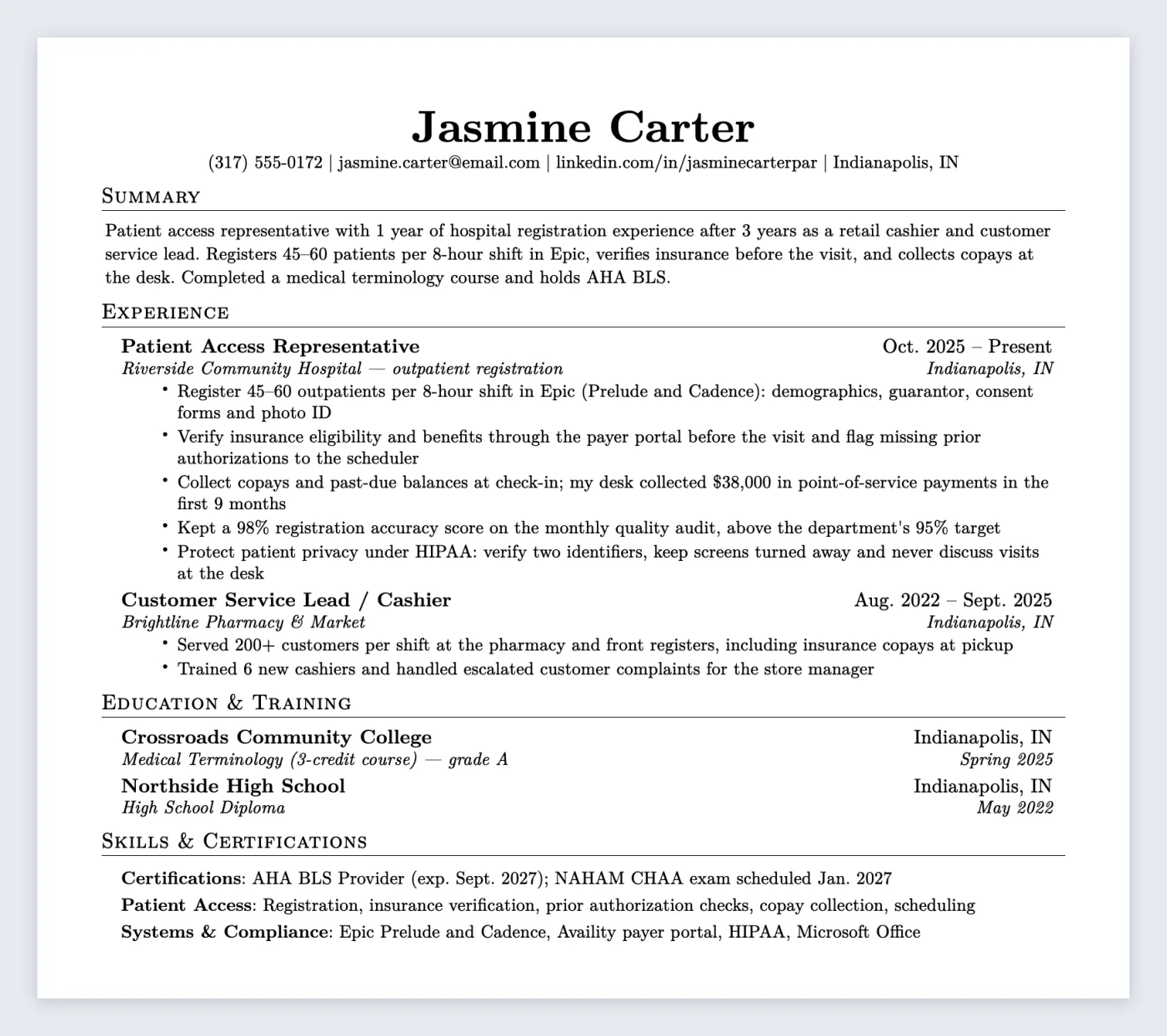
Why this resume works:
- It shows a realistic career change. Three years of retail and pharmacy register work lead naturally into a hospital front desk, where speed, accuracy and calm with upset people matter just as much.
- Every bullet names a healthcare task: registration in Epic, insurance eligibility checks, prior authorization flags and copay collection.
- Quality is measured against the department's own target (98% registration accuracy vs a 95% goal).
- Privacy is shown, not claimed. The HIPAA bullet lists the actual habits a manager wants: two identifiers, screens turned away, no talk at the desk.
Clinical Healthcare Resume Example (Phlebotomist)
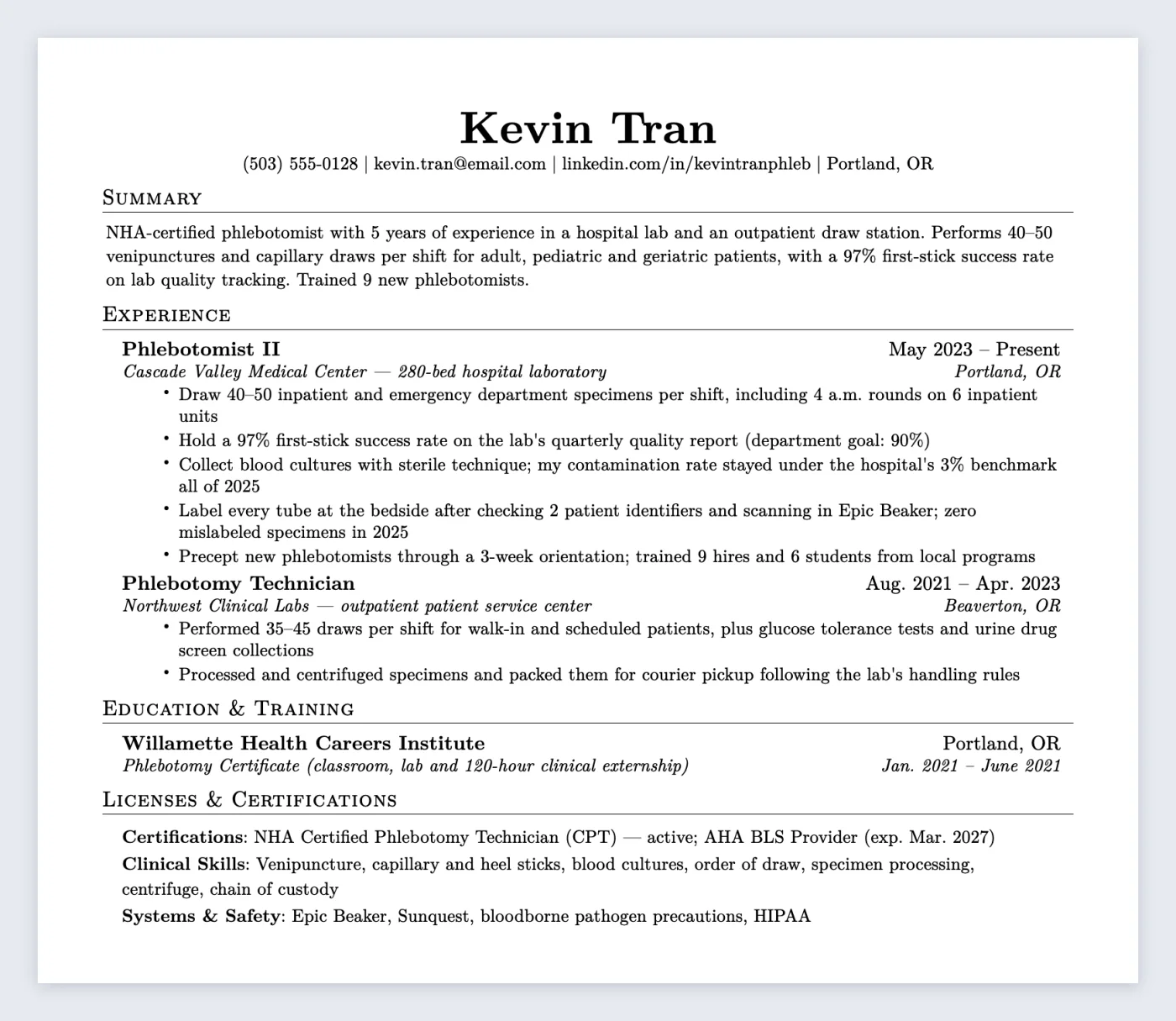
Why this resume works:
- The summary leads with the numbers a lab supervisor checks: 40–50 draws per shift, adult, pediatric and geriatric patients, 97% first-stick success.
- Patient-safety results are specific: blood culture contamination under the hospital benchmark and zero mislabeled specimens in 2025.
- The certification is verifiable. NHA Certified Phlebotomy Technician (CPT) and AHA BLS, each with a status or expiry date.
- It shows growth from an outpatient draw station to a hospital lab, plus a preceptor role training new hires and students.
Senior Healthcare Resume Example (Practice Manager)
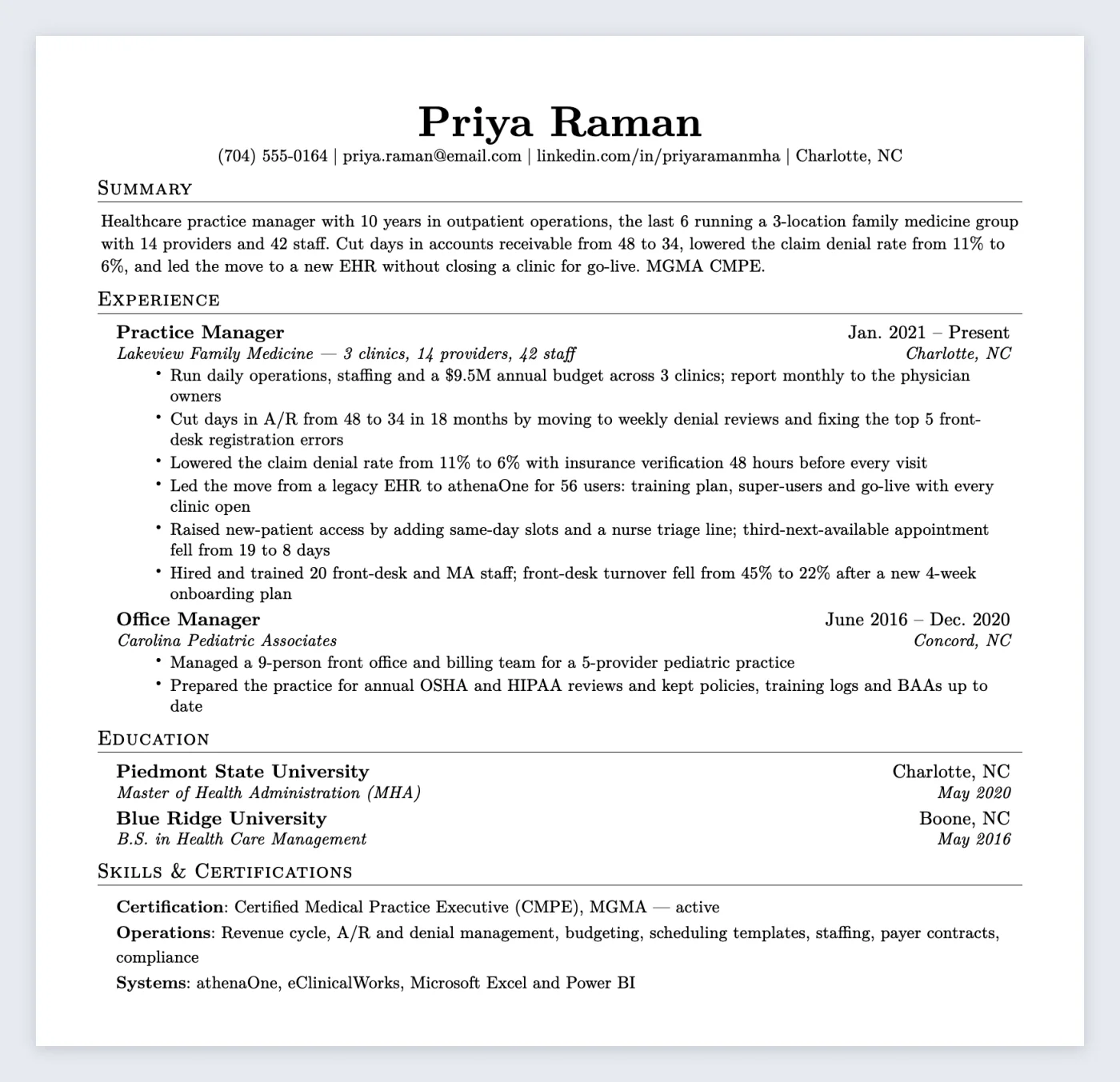
Why this resume works:
- Scope is clear in one line: 3 clinics, 14 providers, 42 staff and a $9.5M budget.
- Results use the metrics practice owners track: days in accounts receivable, claim denial rate, third-next-available appointment and staff turnover.
- Each result explains how it happened, such as insurance verification 48 hours before every visit to cut denials.
- Credentials match the level: a Master of Health Administration and the MGMA Certified Medical Practice Executive (CMPE).
Healthcare Resume Examples by Job
Healthcare is not one job, so the top of your resume changes with the role. Use this table to see what each role should lead with, and open the full guide for examples.
| Role | Lead with | Full guide |
|---|---|---|
| Certified nursing assistant (CNA) | State registry status, BLS, residents per shift, setting | CNA resume examples |
| Medical assistant | CMA, RMA or CCMA, clinical skills, EHR used | Medical assistant resume examples |
| Nursing student / new grad RN | Program and graduation date, clinical hours, NCLEX status | Nursing student resume examples |
| Registered nurse | RN license and state, specialty, unit type, patient ratio | Registered nurse resume example |
| Dental assistant | State registration or DANB credential, radiography, chairside skills | Dental assistant resume examples |
| Phlebotomist | CPT or PBT certification, draws per shift, patient groups | Example above |
| Patient access / front desk | Registration volume, insurance verification, EHR, accuracy | Example above |
| Practice or clinic manager | Clinics, staff and budget, revenue cycle results, CMPE | Example above |
Guides: CNA · medical assistant · nursing student · registered nurse · dental assistant · dental hygienist · pharmacist · physical therapist.
How to Format a Healthcare Resume
Use a single-column, reverse-chronological layout, put licenses and certifications near the top, and save it as a PDF unless the employer asks for Word. Avoid photos, tables, text boxes and two-column designs; hospital ATS software can drop or scramble them.
The right section order depends on where you are in your career:
| Situation | Section order | Length |
|---|---|---|
| New graduate or newly certified | Summary, Licenses & Certifications, Education & Clinical Training, Experience, Skills | 1 page |
| Experienced clinical staff | Summary, Licenses & Certifications, Experience, Education, Skills | 1–2 pages |
| Non-clinical (front desk, billing, admin) | Summary, Experience, Skills & Systems, Certifications, Education | 1 page |
| Career changer into healthcare | Summary, Certifications or Training, Relevant Experience, Other Experience, Education | 1 page |
| Manager or director | Summary, Experience, Education, Certifications, Skills | 1–2 pages |
Physicians, researchers and faculty usually need a CV instead, which lists publications, presentations and training in full and has no page limit.
How to List Licenses and Certifications on a Healthcare Resume
List each credential with its full name, abbreviation, issuing body or state, and status or expiry date. Recruiters verify credentials with the issuer, so the resume line only has to be accurate and easy to find. Your license number is optional unless the application asks for it.
| Credential type | How to write it on your resume |
|---|---|
| State license | Registered Nurse (RN), Texas Board of Nursing — active, multistate (compact) license |
| Life support | American Heart Association (AHA) BLS Provider — expires Mar. 2028; add ACLS or PALS the same way |
| Phlebotomy | Certified Phlebotomy Technician (CPT), NHA — active; or Phlebotomy Technician (PBT), ASCP |
| Patient access | Certified Healthcare Access Associate (CHAA), NAHAM |
| Coding and records | Certified Professional Coder (CPC), AAPC; Registered Health Information Technician (RHIT), AHIMA |
| Management | Certified Medical Practice Executive (CMPE), MGMA |
| In progress | CHAA exam scheduled Jan. 2027 (write the real date; never list a credential you do not hold yet as earned) |
Rules differ by state and role. For phlebotomists, for example, the Bureau of Labor Statistics notes that states may require an accredited training program, a license or a certification, and that employers often prefer certified candidates. Check your state's requirements and use the exact title your state board uses.
How to Write a Healthcare Resume Summary or Objective
A healthcare resume summary is two or three sentences that state your role and credential, your years and setting, and one or two results or numbers. Use an objective only when you are new to healthcare and need to say which job you are aiming for and why you are a fit.
Use this formula: [Role + credential] + [years + setting] + [workload or strongest result] + [skill or system from the job post].
Career changer (objective):
Customer service lead with 3 years in a busy pharmacy, now seeking an entry-level patient access role. Handles 200+ customers per shift, collects insurance copays at pickup and completed a college medical terminology course. AHA BLS certified and bilingual in English and Spanish.
Clinical (summary):
NHA-certified phlebotomist with 5 years in a hospital lab and an outpatient draw station. Performs 40–50 draws per shift for adult, pediatric and geriatric patients with a 97% first-stick success rate and zero mislabeled specimens in 2025.
Non-clinical (summary):
Patient access representative registering 45–60 patients per shift in Epic Prelude and Cadence. Verifies insurance before every visit, collects point-of-service payments and holds a 98% registration accuracy score.
Management (summary):
Practice manager with 10 years in outpatient operations, the last 6 running a 3-clinic family medicine group with 42 staff. Cut days in A/R from 48 to 34 and lowered the claim denial rate from 11% to 6%. MGMA CMPE.
Healthcare Resume Bullet Points
Strong healthcare bullets follow one pattern: action verb + the care or task + volume or setting + a result, safety catch or quality score. Never include anything that could identify a patient.
Clinical and patient care
- Cared for up to 10 patients per 12-hour shift on a 36-bed med-surg unit, documenting vital signs and intake and output in Epic.
- Recognized a sudden drop in a patient's blood pressure and escalated it to the charge nurse using SBAR; the rapid response team arrived within minutes.
- Labeled every specimen at the bedside after checking two patient identifiers; zero mislabeled specimens in 2025.
Front desk, patient access and billing
- Registered 45–60 patients per shift and verified insurance eligibility before each visit, keeping registration accuracy at 98%.
- Collected $38,000 in copays and past-due balances at check-in over 9 months.
- Coded outpatient visits with ICD-10-CM and CPT codes and cut coding-related denials by 30% in one year.
Lab, imaging and pharmacy support
- Performed 40–50 venipunctures per shift with a 97% first-stick success rate on quarterly quality reports.
- Filled 250+ prescriptions per shift as a certified pharmacy technician and caught 3 duplicate-therapy orders for pharmacist review.
Management and operations
- Cut days in accounts receivable from 48 to 34 in 18 months with weekly denial reviews and front-desk registration fixes.
- Led an EHR migration for 56 users across 3 clinics without closing a clinic for go-live.
Healthcare Skills and ATS Keywords
Most hospitals and large health systems screen applications with an ATS, which compares your resume with the job post. Use the exact words from the posting, both the full term and the abbreviation, and only where they are true for you.
| Keyword group | Keywords to include (if you have the experience) |
|---|---|
| Patient care | patient care, vital signs, patient assessment, care plan, patient education, infection control, fall prevention |
| Patient safety | two patient identifiers, specimen labeling, SBAR, hand hygiene, PPE, isolation precautions, incident reporting |
| Systems | electronic health record (EHR), Epic, Oracle Health (Cerner), Meditech, athenaOne, eClinicalWorks, PointClickCare |
| Compliance | HIPAA, OSHA, The Joint Commission, bloodborne pathogens, confidentiality, documentation standards |
| Administrative | patient registration, insurance verification, prior authorization, scheduling, ICD-10-CM, CPT coding, revenue cycle |
| Credentials | BLS, ACLS, PALS, CPR, state license, certification names written in full plus the abbreviation |
- Clinical skills you can do on day one, named specifically (venipuncture, 12-lead EKG, wound care, injections)
- The EHR and practice systems you have actually used, with module names if you know them
- Patient safety habits: identifiers, labeling, infection control, escalation with SBAR
- Privacy and compliance: HIPAA, OSHA, documentation rules
- Communication: patient education, calming anxious patients, working with interpreters
- Languages spoken with patients, and your level
- For admin roles: registration, insurance verification, coding and billing terms
- For leaders: staffing, budgets, quality metrics and training programs
For a deeper look at how applicant tracking systems read your resume, see our ATS resume guide.
How to Write a Healthcare Resume With No Experience
Many healthcare jobs hire people with no healthcare background, especially in patient access, phlebotomy, nursing assistant, medical assistant and pharmacy technician roles. Phlebotomists, for example, typically enter the field with a postsecondary nondegree award, a short certificate program rather than a degree, according to the BLS Occupational Outlook Handbook. To show you are ready:
- Get one entry credential first, such as AHA BLS, then a role certificate (CNA, phlebotomy, medical assistant) if the job requires it.
- List training and clinical hours like a job, with the setting, hours, patient load and the skills you performed.
- Translate your current work into healthcare terms. Retail becomes "payment collection and customer de-escalation"; food service becomes "accuracy under time pressure and food safety rules".
- Add volunteering at hospitals, clinics, senior centers or blood drives, with hours.
- Show languages and reliability. Bilingual staff and people who show up for every shift are hired quickly in healthcare.
The patient access example above shows this path: a retail cashier who moved into hospital registration. If you are coming from a store job, our cashier resume examples show how to put numbers on that experience first.
Common Healthcare Resume Mistakes
- Listing credentials without a status or state. "RN" or "CNA" alone forces the recruiter to guess.
- Including patient information. Never include names, room numbers, dates of service or anything else that could identify a patient; HIPAA and your employer's privacy rules still apply.
- Expired certifications. Renew your BLS before you apply, or leave it off.
- Duty-only bullets such as "Responsible for patient care". Say how many patients, in what setting, and what happened.
- Only abbreviations. Write "electronic health record (EHR)" and "Basic Life Support (BLS)" once so both versions match.
- One resume for every job. A hospital lab job and an outpatient clinic job ask for different keywords; adjust your summary and top bullets for each.
Frequently Asked Questions
What should a healthcare resume include?
A healthcare resume should include your contact details, a short summary, your licenses and certifications with state or issuer and status, your work experience with patient loads and measurable results, your education and clinical training, and a skills section that names the systems you use. New graduates should add clinical rotations and hours.
How do I write a healthcare resume with no experience?
Lead with a short objective that names the role you want, then list any certification (such as BLS, CNA or phlebotomy), training hours, volunteering and transferable work. Customer service, cash handling and calm with upset people are valuable in patient access and front-desk roles. Put numbers on everything you can.
What is a good summary for a healthcare resume?
A good healthcare summary has your role and credential, years and setting, and one or two numbers. Example: "NHA-certified phlebotomist with 5 years in a hospital lab. Performs 40–50 draws per shift with a 97% first-stick success rate." Keep it to two or three sentences.
Should I put my license number on my resume?
It is usually optional. Write the license type, state or issuer and status, for example "Registered Nurse (RN), Texas Board of Nursing — active". Employers verify licenses with the state board, and applications often ask for the number separately. Include it if the job post asks for it.
How long should a healthcare resume be?
One page for entry-level, support and most non-clinical roles. Experienced clinicians and managers can use two pages if every line is relevant. Physicians, researchers and academics usually need a longer CV.
Should I send my healthcare resume as a PDF or a Word file?
Send a PDF unless the job post or online application asks for Word. A PDF keeps your formatting the same on every screen. Use a simple single-column layout either way, so the ATS can read it.
What are the best skills for a healthcare resume?
Role-specific clinical or administrative skills (for example venipuncture, vital signs, insurance verification or medical coding), the EHR systems you have used, patient safety and infection control, HIPAA compliance, patient communication and any languages you speak. Match them to the words used in the job post.
Is healthcare a good field to get into?
By the numbers, yes. The U.S. Bureau of Labor Statistics projects employment in healthcare occupations to grow much faster than the average for all occupations from 2025 to 2035, with about 1.9 million openings each year. The median annual wage in May 2025 was $86,530 for healthcare practitioners and technical occupations and $38,340 for healthcare support occupations, compared with $50,980 for all occupations. Source: BLS Occupational Outlook Handbook, Healthcare Occupations.
Build Your Healthcare Resume for Free
The button below opens the builder with the same Jake template used in the examples above. Add your licenses, experience and skills, and download an ATS-friendly PDF without a watermark; the free plan includes 8 PDF downloads a month. No sign-up is needed to start.
Turn your credentials and patient care experience into a healthcare resume that gets interviews.
Build My Healthcare Resume FreeBrowse role guides for CNAs, medical assistants, nursing students and dental assistants, or see all resume templates.